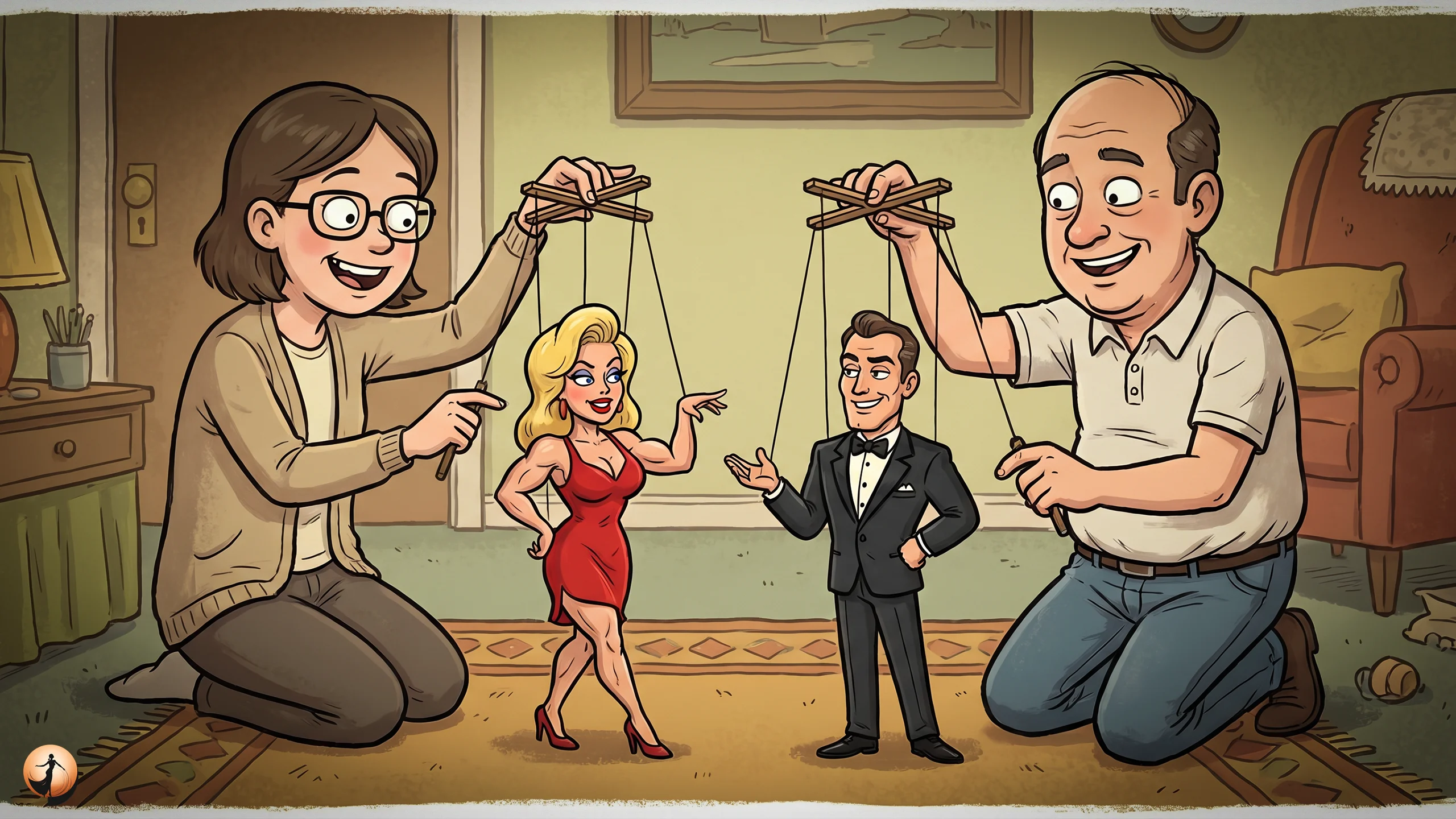
Why We Look the Way We Look in Virtual Worlds
In 3DX, nobody enters the room as a neutral presence. Before we speak, flirt, dance, pose, host, perform, or disappear quietly into a corner, we have already made a statement. Hair, face, body, clothes, tattoos, height, elegance, exaggeration, realism, fantasy. The avatar arrives first.
And in a world like 3DX, that matters.
Dress Like a God, Behave Like One
Researchers have been studying this for years. One of the best known ideas is the Proteus effect, first described by Nick Yee and Jeremy Bailenson, which suggests that the appearance of an avatar can influence how the person behind it behaves. In simple terms, when we look confident, attractive, powerful, glamorous, dangerous, innocent, or mysterious, we may begin to act a little more like that too. Later reviews have refined and challenged parts of the theory, but the central observation remains important: avatars are not just costumes. They can shape behaviour, expectation, and self perception.
It’s Not a Game. It’s a Stage.
This is especially visible in social virtual worlds. Unlike many games, 3DXChat, Second Life, and Red Light Center are not built around winning. They are built around being seen. Second Life, launched publicly in 2003, famously positioned itself as a world without fixed objectives, while Red Light Center arrived in 2005 as an adult virtual world built around socializing, clubs, fantasy, and intimacy. 3DX follows that same lineage, but with a more modern emphasis on lifelike adult avatars and sensual interaction.
And then there is the avatar itself. An avatar is not just a puppet. It is an extension of identity. Sometimes it reflects who we are. Sometimes who we wish we were. This flexibility allows people to explore emotions, roles, and even vulnerability in ways that real life does not always permit.
In these places, appearance becomes language.
The Comfort of Being Recognisable A stable avatar can become a signature. You recognise the silhouette before the name loads. The same hairstyle, the same face, the same style of dress. It says: this is me. For some people, consistency builds trust. It gives friends and partners something familiar to attach to. In a world where names can change, rooms vanish, relationships flare and fade, a consistent avatar can feel almost comforting.
New Face, New Mood, New You
But constant change says something too.
The player who redesigns themselves every week may not be indecisive. They may be exploring. Research on avatar self representation suggests that people often balance two impulses: self verification, meaning “this is close to who I feel I am”, and self enhancement, meaning “this is who I would like to be, or how I would like to feel tonight.” One study found that people often create avatars that are improved versions of themselves, but not necessarily total fantasies. The avatar becomes a negotiation between truth and wish.
From Blocky Puppets to Digital Bodies
That makes 3DX especially interesting. Its avatars are realistic enough to feel intimate, but flexible enough to support fantasy. A player can appear as a polished ideal, a heightened version of their offline self, a role-play character, a sexual persona, or simply “the mood of the evening.” In older worlds like Habitat and WorldsAway, avatars were simple graphical figures, closer to symbolic puppets than bodies. Habitat began in the mid 1980s as one of the first graphical virtual worlds, while WorldsAway in the 1990s offered two dimensional avatar identities with chat, gestures, geography, and economy.
The more realistic avatars became, the more personal the choices became.
Second Life pushed this forward through user created bodies, skins, clothing, attachments, and eventually mesh avatars. Red Light Center allowed users to customize gender, clothing, skins, tattoos, makeup, and accessories. 3DX simplified some of that complexity but focused heavily on visual polish, bodily presence, and erotic immediacy.
The More Real It Looks, the More It Matters
Realism changes the emotional stakes. A cartoon avatar can be expressive, but a lifelike avatar invites a different kind of projection. The closer the body feels to a person, the easier it becomes to desire, judge, compare, trust, or mistrust it. In adult worlds, this becomes even more charged. Sexuality is not separate from identity here. It is one of the main ways identity is performed.
So… Who Are You Tonight?
So why does one person make themselves impossibly glamorous, while another chooses casual realism? Why does one person stay recognizable for years, while another reinvents themselves every login?
Because the avatar answers a question we rarely ask out loud:
Who do I want to be in this room?
Sometimes the answer is “myself, but freer.”
Sometimes it is “someone nobody expects me to be.”
Sometimes it is “someone desirable.”
Sometimes it is “someone safe.”
Sometimes it is “someone new.”
When the Mask Becomes the Face
And sometimes, perhaps most interestingly, the avatar becomes real through repetition. Not real in the biological sense, of course. But socially real. Emotionally real. If people know you by that face, love you through that body, remember you in that dress, that look becomes part of your identity.
In 3DX, we often talk about rooms, parties, relationships, drama, and desire. But underneath all of it is the silent art of self creation. Every avatar is a small autobiography, even when it lies. Especially when it lies.
Because in virtual worlds, appearance is never just appearance.
It is invitation.
It is armour.
It is fantasy.
It is confession.
— 30 —
Bettsi
A very interesting and thoughtful article. Those who know me will almost certainly know which category my avatar falls into. Possibly a more interesting angle with mine, is that if fulfills two objectives simultaneously. One, the 'this is me' function, and two, it also gives an expression to my 'alter ego', this is still me but is also the expression of my virtual singer-songwriter persona. The two are just two similar facets of the same person. It was never my intention, or ever of interest to me to create a fantasy figure in 3dx. The aim was just to place myself, as close as I could get in appearance and character, into a weird and, as it was when I started, unknown and slightly scary virtual world. In the six years I've been here that aim has never changed.
Reply
Petra
Yes, a good and certainly interesting article. Initially, I wanted to try to make my avatar look as much like myself as possible, but unfortunately, that isn't possible due to the limited face and body settings. When I first entered the game, I didn't look like myself at all and didn't make any effort to do so; I just wanted to explore the game quickly. Later, when I understood the settings a bit better, I made my avatar look a bit more like myself, but it doesn't come very close. I'm still not satisfied, but I accept how it is now. Regarding my clothing, I can generally say that, just like in real life, I like to look feminine. And yes, I am a lesbian, but on the feminine side. Sometimes I like to look a bit more extreme in certain rooms, which my girlfriend naturally notices immediately, but she always enjoys it. I also notice the "WOW" shouts from my friends because they aren't used to seeing me like that. I have to say that it does feel strange because that isn't who I am, and I would never wear such clothes in real life. The only thing I change quite a bit, just like in real life, is my hair. It is nice to see how that changes your appearance too. Then there is my character. I am not playing a game, but simply being myself, just as I am in real life. That way, I never have to lie or remember what I said to whom. I am certain that others know me for who I am, my character, and my behavior.
Reply