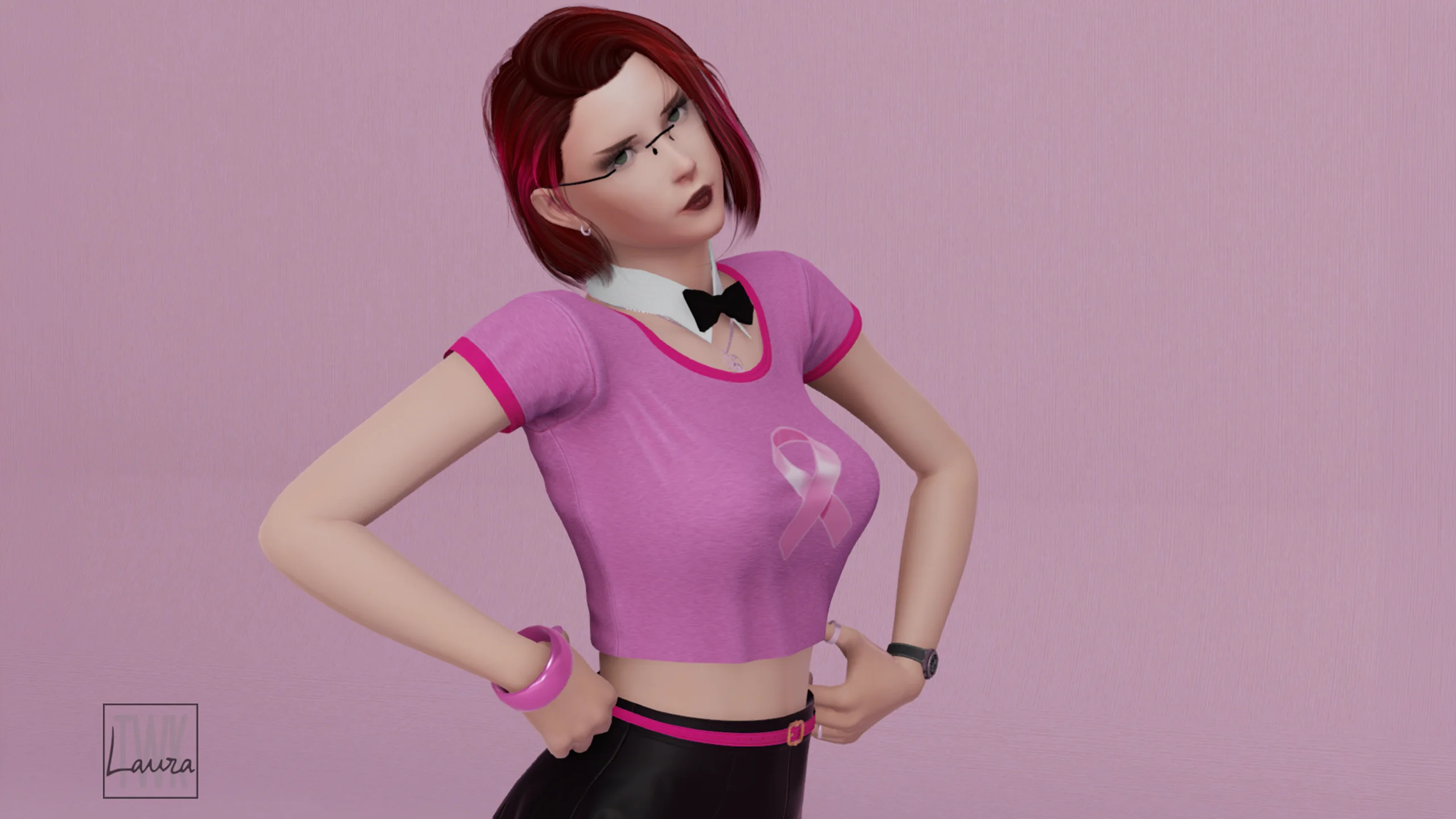
What I've Learned Writing About Breast Cancer Awareness
I've been writing about Breast Cancer Awareness Month for six years now. That's six Octobers of pink ribbons, six years of "did you know?" facts, six years of trying to find a new way to say the same thing.
And here's what I've learned: the message hasn't changed, but the way we need to say it has.
When I started, I wrote long essays packed with statistics and compelling arguments. I wanted to shake people into action. I told them breast cancer is the most common cancer among women worldwide. I told them 1 in 8 women will be diagnosed in their lifetime. I told them that when detected early, the five-year survival rate is 99% but, when it's caught late, that number drops dramatically.
All of that is still true. All of it still matters.
But over six years, I've watched those statistics become background noise. Not because people don't care, but because they've heard it all before. We've all been told to check our boobs, know the signs, go for our screening, know our family history. The advice is everywhere.
And yet, new research from Breast Cancer Now shows that 45% of UK women still don't check their breasts regularly, even if that figure has actually risen by 4% since 2022. The number of women who have never checked their breasts has gone up too, to 11%. The barriers are depressingly mundane: forgetting (46%), not being in the habit (36%), lacking confidence (17%), and not knowing how (13%). And of the women who do check, nearly a third say they don't feel confident they'd notice a change anyway.
So this year, rather than another lecture, let's just have a conversation
Awareness isn't the same as action
The uncomfortable truth is that awareness campaigns have a ceiling. You can make someone aware of something and still not change their behaviour. You can put a pink ribbon on a coffee cup, and someone will see it, and they'll think "oh yes, breast cancer," and then they'll go about their day.
That's not failure. That's just the limit of what a ribbon can do.
What actually changes behaviour is more human than that. It's a conversation. It's someone saying "I noticed something different about my body and I got it checked, and it was nothing, and that was fine." It's a friend reminding you that you're due for a mammogram. It's the quiet realisation that you haven't actually paid attention to your own body in years.
The pink ribbon is the signpost. It isn't the destination.
The things that actually matter (and the things that don't)
After six years, I've distilled the message down to a few things that are genuinely worth knowing.
Know what's normal for you. Not what a diagram looks like. Not what a magazine says. You. Breasts come in different shapes and sizes and change throughout your life - hormones, age, pregnancy, all of it. The useful question isn't "do mine look like the picture?" It's "do mine normally look and feel like this?"
You don't have to diagnose yourself. This is the one I wish more people understood. If you notice a change, your job isn't to work out what it is. Your job is to notice something that isn't normal for you and get advice. A change doesn't automatically mean cancer. But "it's probably nothing" isn't a diagnosis either. You don't need to be certain something is wrong before asking for help. "This is different for me and I'm not sure whether I should be worried" is enough.
Screening isn't a pass or fail. It's easy to put off. You're busy, you feel fine, you'll sort it next week. But screening looks for changes that haven't caused symptoms yet. It isn't perfect, and it can't guarantee anything, but it's an important part of catching breast cancer earlier. And being called back for further tests doesn't automatically mean you have cancer.
Risk isn't destiny. There are things that influence risk: age, family history, genetics, alcohol, physical activity, body weight. Making healthier choices can reduce risk. But nothing provides a guarantee. You can do everything "right" and still get cancer. Health is complicated. The goal isn't perfection. Small, realistic changes are still worthwhile.
The commercialisation question
Every October, someone asks whether Pink October has become more about marketing than meaning. It's a fair question. The wave of pink-branded products is impossible to ignore, and some companies contribute little or nothing to breast cancer organisations while using the cause to sell things.
But dismissing the whole movement as a marketing exercise misses the point.
The pink ribbon was never meant to be a sales tool. It started in the early 1990s as a symbol of solidarity. A way of telling women and families facing breast cancer that they weren't alone. What began as a grassroots emblem became a global movement, and by the end of that decade, October had been recognised as Breast Cancer Awareness Month across much of the world.
Since 2002, the UK's Wear It Pink day alone has raised over £33 million for research. That's not nothing. And even when a product isn't funding research, its visibility still sparks conversations. A pink ribbon on a coffee cup might seem small but, contrary to what I said at the start, for someone who's been putting off booking a mammogram, that reminder can be the nudge that changes everything.
Commercialisation becomes a problem when it's disconnected from genuine action. When pink campaigns stay tied to research, education, and advocacy, they amplify awareness far beyond what traditional fundraising alone could achieve.
What's changed since 2021
The conversation has broadened. When I started writing about this, the focus was heavily on self-checks and mammograms. Important, yes, but not the whole picture.
Today, awareness campaigns increasingly acknowledge that men can develop breast cancer too. In the UK, around 400 men are diagnosed each year, accounting for less than 1% of cases. That's not a huge number, but it's not zero either, and men with a family history or BRCA mutations face elevated risk.
The conversation has also shifted to acknowledge that Black women are disproportionately affected by later-stage diagnoses and lower survival rates, though there are encouraging signs that awareness is growing in these communities, with almost half of Black and South Asian UK women now checking regularly, up 9% since 2024. The caveat: 15% of those women have still never checked.
Genetic risk awareness has grown too. BRCA mutations, family history, genetic counselling - these are now part of the mainstream conversation. And mental health support is increasingly recognised as just as important as medical treatment. The emotional toll of living with or after cancer doesn't end when treatment does.
Advocacy has grown stronger as well. Campaigns now push for policy changes around healthcare access, equitable treatment, and research funding, not just awareness. The global dimension is impossible to ignore.
The numbers, updated for 2026
One of the things I've learned over six years is that statistics have a shelf life. So let me give you the current picture, as accurately as I can.
Globally, breast cancer remains the most common cancer among women. An estimated 2.3 million new cases were diagnosed worldwide in 2022, with 670,000 deaths. Projections suggest that by 2050, those figures could rise to 3.2 million new cases and 1.1 million deaths annually. That growth will disproportionately affect countries with lower Human Development Indexes, where access to screening and treatment is already limited.
In the UK specifically, around 56,000 women are diagnosed each year, and around 11,000 die. Someone dies from breast cancer in the UK every 45 minutes.
The survival statistics tell a story of genuine progress and genuine inequality. In the UK, five-year survival for Stage I breast cancer is now 98%, and for Stage II it's 90%. But for Stage IV, it drops to 27%.
In the US, the figures are similar at 99%, 86% and 30%, respectively.
That gap between early and late detection is the entire point of awareness. It's not about scaring people. It's about making sure they understand that the difference between a Stage I diagnosis and a Stage IV diagnosis isn't just a number on a chart. It's the difference between a 98-99% chance and a 27-30% chance.
And those numbers matter because behind every statistic is a person. Someone with a family, a partner, friends, a job, pets, plans, and somebody waiting for them to come home. Breast cancer doesn't just affect the person who receives the diagnosis. It affects everyone around them.
What I've learned
Six years of writing about the same thing teaches you a few lessons.
People don't respond to fear. They respond to feeling capable. The message that works isn't "you might die." It's "you can do something about this, and it's not that hard."
Repetition isn't failure. The fact that we're still having this conversation every October doesn't mean nothing has changed. Breast cancer mortality rates have dropped significantly over the past few decades — in the UK, five-year survival has gone from 59% in 1980 to around 90% now. That's progress. It may not feel like it when I’m writing the same post for the sixth year in a row but it is real and tangible progress.
The personal always beats the statistical. I've written thousands of words about survival rates and screening programmes and risk factors. But the thing that actually gets people to book an appointment is usually much simpler. It's a friend saying "I went for mine last week, it took twenty minutes." It's a colleague mentioning that her mum was diagnosed at 52 and is fine now. It's the ordinary, unremarkable reality of people taking care of themselves.
And the most powerful thing you can do is just ask. Not panic. Not Google yourself into oblivion. Not assume the worst. Just ask. Check. Book. Find out.
No lecture. Just a nudge.
I'm not going to finish this by shouting "GO CHECK YOUR BOOBS RIGHT NOW!" You already know you're supposed to.
Instead, just ask yourself a few simple questions:
- Do I know what's normal for me?
- Do I know when I'm due for screening?
- Do I know my family history?
- Have I noticed a change I've been ignoring?
- Have I been putting off an appointment because I'm worried I'll be wasting someone's time?
If everything is fine, brilliant. If something needs investigating, you've started the process of finding out what it is. Either way, you've replaced uncertainty with information.
And maybe that's what Pink October should really be about. Not more lectures. Not more fear. Not another wall of statistics that everyone scrolls past.
Just a reminder to pay a little attention to ourselves, have the conversations we're sometimes reluctant to have, and look after the people around us.
The internet can turn pink for a month. That's fine. But if that little pink ribbon makes somebody stop and think, "When was the last time I actually paid attention to me?", then it's done its job.
Happy Pink October. Now go eat something that isn't pink. Unless it's a doughnut. In which case, carry on.

— 30 —
0 Comments
No comments yet.
Leave a comment
Your email is optional and never shown. Comments are checked for spam; posts from readers with scripting disabled are held for a moderator.