The Isles of Soleil Libre are an idyllic 3DX naturist hideout created by Jenne. These Isles represent a life style that harks back to the very core of what it means to be human. In part 1 Jenne introduced us to the extensive mythology of the isles. In part 2 we learn more about Solara and the ache she finds in mankind.
Chapter 2 — Solara’s Wandering
An original story by Jenne
Solara did not descend from the sky in a blaze of fire or thunder. She arrived quietly, the way warmth arrives on the skin — slowly, gently, without demanding attention. She walked the world in human shape, barefoot, bare‑shouldered, unadorned, so she could feel the earth as humans did.
She wandered through forests where the wind whispered secrets through the leaves, but the people who passed beneath them walked wrapped in heavy cloth, never letting the breeze touch their skin. She crossed deserts where the sun poured its gold onto the sand, but travelers shielded themselves from its warmth as if sunlight were a threat instead of a gift. She visited villages by the sea where waves rose and fell in a rhythm older than memory, but the people stood at the shore’s edge, hesitant to enter the water as they were.
Everywhere she went, Solara saw the same thing: humans longing to feel the world, yet afraid to be felt by it.
She watched a young woman sit by a river, dipping only her fingertips into the water, though her whole body yearned to be submerged. She watched a man remove his shirt in the heat, only to pull it back on when others approached, as if comfort were something shameful. She watched children run freely until adults taught them to cover themselves, to shrink, to hide.
Solara felt their longing like a pulse beneath her ribs.
She understood that humans were not born afraid of their bodies — they were taught to be. They were taught that the body was something to manage, to correct, to conceal. They were taught that the world would judge them if they dared to feel it fully.
And so they lived half‑alive, half‑present, half‑touched.
Solara wandered for many years, though time meant little to her. She listened to the quiet ache in people’s hearts — the ache of wanting to be unburdened. She saw how they softened when alone, how they stretched when unobserved, how they smiled when sunlight warmed their skin unexpectedly.
She realized something profound:
Humans did not need a paradise.
They needed permission.
Permission to breathe deeply.
Permission to feel the wind on their skin.
Permission to let the sun rest on their shoulders.
Permission to exist without armor.
Solara knew she could not change the entire world at once. But she could create a place — a sanctuary — where humans could remember what it felt like to be whole.
A place where the body was not a source of shame, but a vessel of sensation. A place where the world touched you gently, and you touched it back. A place where warmth was not feared, but welcomed.
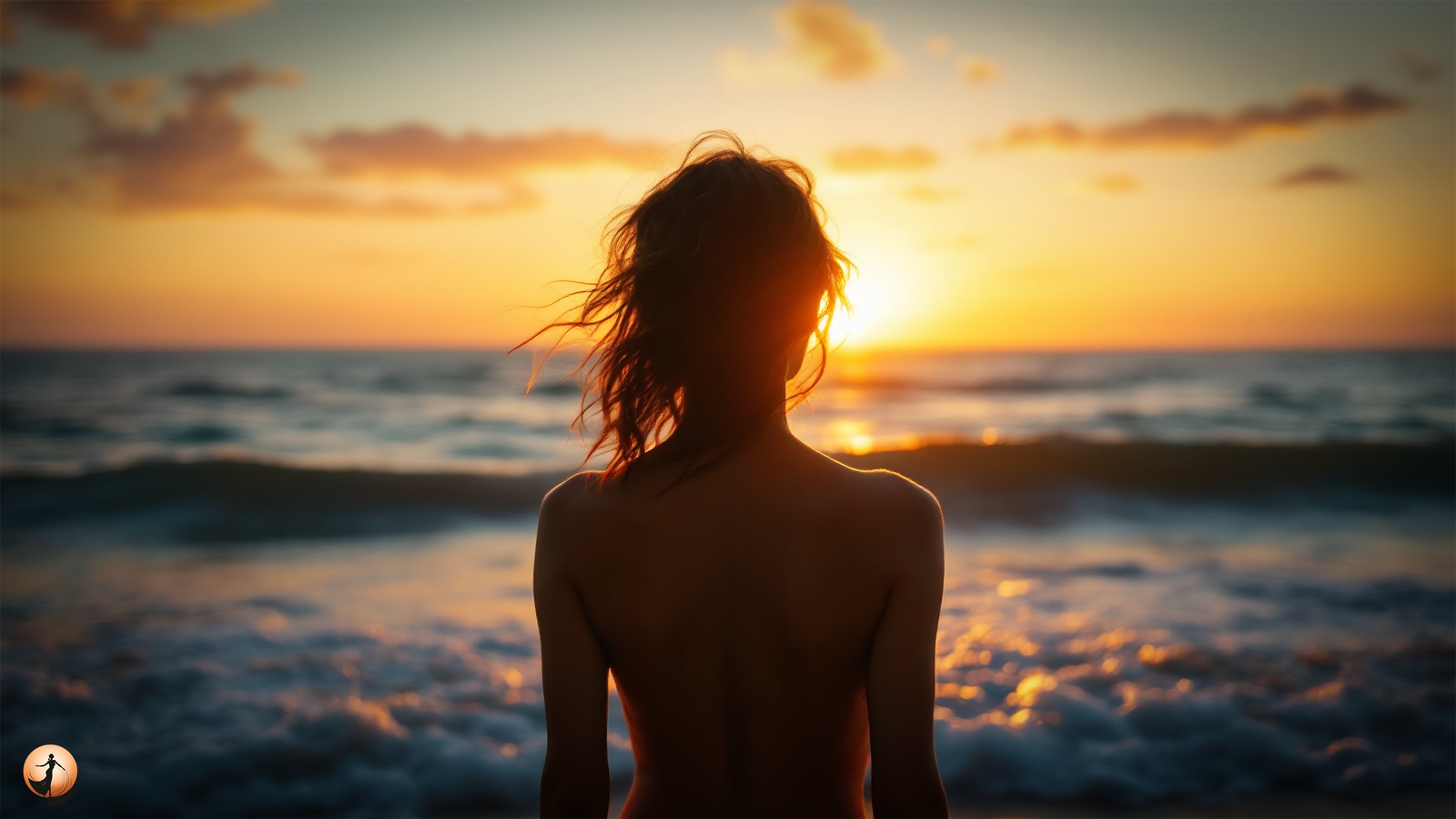
And so, after many years of wandering, Solara turned toward the sea — toward the horizon where the sun kissed the water each evening. She felt the world calling her, inviting her to begin.
The sanctuary she envisioned would not be built by hands. It would rise from light, from warmth, from the simple truth that the body is sacred because it is alive.
Solara stepped into the golden water, ready to reshape the world.
The age of coverings was ending.
The age of warmth was about to begin.