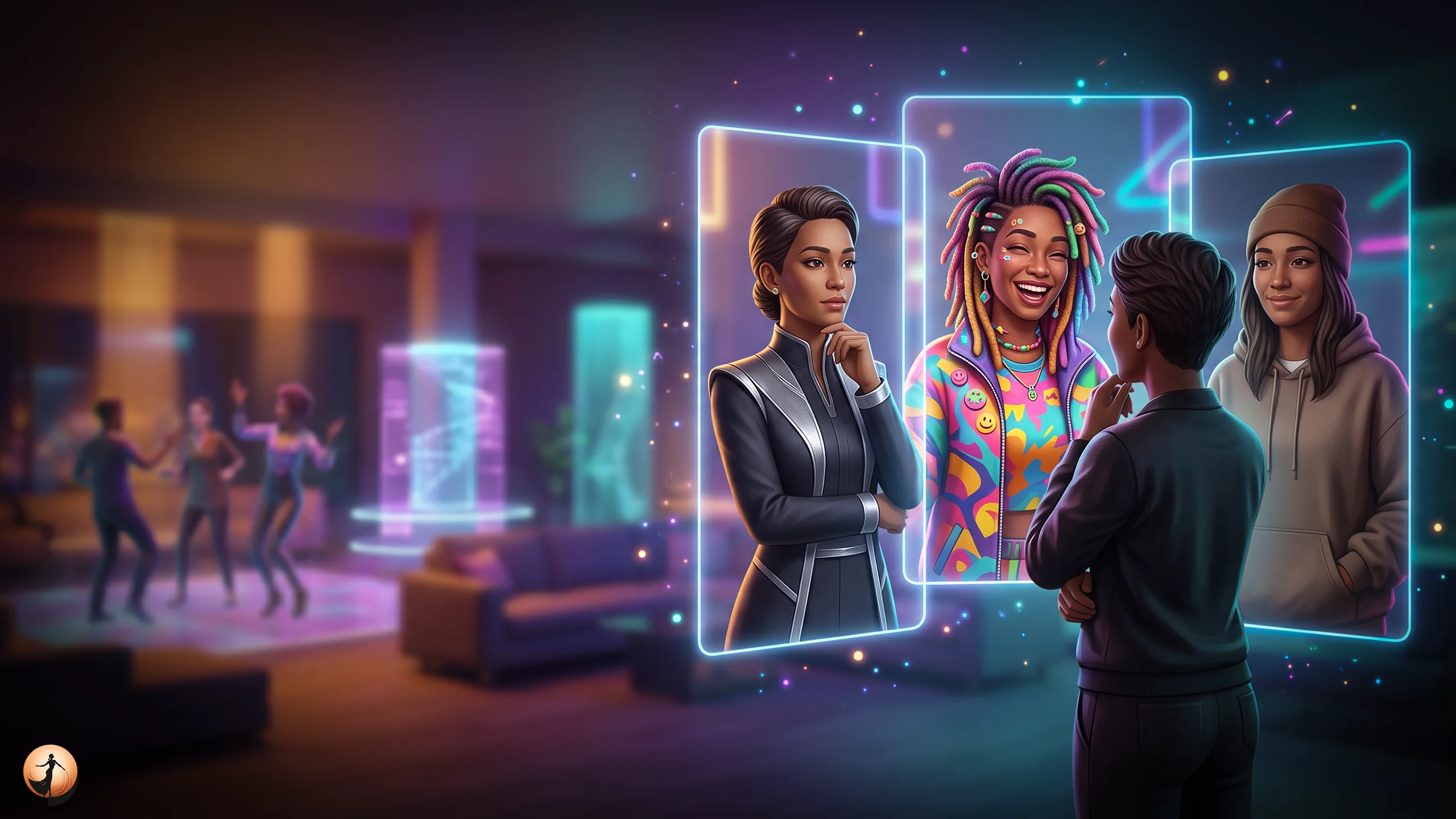
Why We Create Alts
Some evenings, you log into 3DXChat ready to see everyone. Other evenings, you would quite like to slip into a room, listen to the music, and avoid explaining where you have been for the past three days.
Enter the alt.
A different name. A different face. Perhaps a completely different personality. Or perhaps exactly the same person, enjoying a little less attention.
Alternative avatars have been part of online worlds for decades, yet they still have a way of making people suspicious. “That’s someone’s alt” can sound less like an observation than an accusation.
But behind that unfamiliar face could be a roleplayer, a curious newcomer to another gender expression, a host taking the evening off, or someone who simply got carried away in character creation.
There are plenty of reasons to create another you.
Because one character can’t have all the fun
In games such as World of Warcraft, creating another character is an obvious way to try something different. Tired of being a warrior? Be a priest. Want to see the other side of the story? Start again somewhere else.
In EVE Online, even the official player guide suggests using alts to explore different specialities. Your main might be busy with combat while another character develops manufacturing skills. Very practical. Almost disappointingly respectable for something that can sound so mysterious.
In 3DXChat, the possibilities are different, but the appeal is familiar. You might want another look, another gender presentation, or a character who dresses and behaves nothing like your usual self.
Perhaps your main is elegant and reserved, while your alt has questionable fashion sense and never leaves the dance floor.
It does not always need a deeper explanation. Creating characters is fun. Sometimes we make another one because we have an idea and want to see where it goes.
Because starting again feels good
One of the nicest accounts I found came from a World of Warcraft player who had become a parent. They used to raid, lead raids, and play competitively. With a newborn daughter, their priorities changed. Levelling alts became something relaxing to enjoy with their wife or while caring for the baby. They described it as “essentially a cozy game.”
That is a rather different picture from the secretive troublemaker people sometimes imagine.
Other players describe the pleasure of familiar landscapes, music, and slowly learning a new character. One called the experience “cathartic and meditative.” These are personal stories, rather than evidence that everyone feels the same, but they capture something recognisable: a fresh start can be comforting.
You do not necessarily want to abandon your old character. You just want to enjoy the beginning again.
In a social world, the equivalent might be entering a room without an established reputation. Nobody knows your usual seat, your friends, your history, or what you are supposedly like. There is something appealing about having room to surprise yourself.
Because being yourself can mean trying someone else
We tend to talk about an alt as if it must be a disguise. Sometimes it is a way of expressing something that the main leaves out.
A quieter person might enjoy playing someone bold. Someone might explore another gender expression, a different style, or a fictional character with a life of their own.
Research into avatars describes this range: characters can resemble who we are, who we would like to be, or someone quite different from either. That does not explain every alt, but it makes the urge to experiment easier to understand.
And experimentation does not have to lead to a grand revelation. You might discover something meaningful about yourself. You might discover that you really enjoy wearing purple.
Both are perfectly good outcomes.
Because sometimes you want an evening off
Imagine being known as a host, DJ, builder, or the person who always knows what is happening.
You log in for a quiet hour. Three messages arrive. Someone needs help. Someone wants you at their event. Someone wants to know why you went to another event instead.
All lovely people, perhaps. Still quite a lot for a Tuesday.
An alt can offer breathing room. You can enjoy the world without immediately stepping into your usual role.
Second Life explicitly recognises privacy, building, and scripting as legitimate reasons to have another account. Its published forum guidelines also protect residents from having their alternate-account names disclosed by others. There is an established place for keeping identities separate.
Wanting that separation does not automatically mean you dislike your friends or have something sinister planned. Sometimes you would just like to listen to the DJ without becoming the evening’s customer-support desk.
Then feelings get involved
Of course, another character does not always stay a simple creative experiment.
Suppose you meet someone, become friends, and share things you would not tell everyone. Later, you discover that they are also another person you have been talking to.
They might say, quite sincerely, “But those are two different characters.”
You might say, equally sincerely, “I told both of you different things because I thought you were two different people.”
That is where the subject becomes complicated.
Some players draw a strong line between character and player. Others feel that the person behind the keyboard is the relationship, whatever name appears above their head. Many sit somewhere between those positions.
Neither side can safely assume everyone else sees it the same way.
You do not owe every passing acquaintance a full tour of your character-selection screen. But when friendship or romance becomes important, it helps to know what you are agreeing to. Does an agreement apply to one character or all of them? Is this shared fiction, a personal relationship, or a mixture?
Those conversations may be awkward. Discovering the answers by accident can be considerably worse.
And sometimes, it really is a problem
There is a clear difference between enjoying a private identity and using one to push past someone’s boundaries.
Coming back under another name after being told to stop contact is an obvious example. So is posing as a new friend to collect information, or using several avatars to make a personal accusation look like a community consensus.
At that point, the new character is serving a harmful purpose.
It is understandable that people ask why a platform cannot simply identify the owner and act. Sometimes platforms do link accounts: in 2023, Valve announced that it had banned 90,000 Dota smurf accounts and traced them to their mains. But that tells us about Valve’s reported capabilities, not what 3DXChat can establish in an individual case.
3DXChat prohibits harassment, but its public rules do not explain how it connects accounts during investigations. A familiar phrase or suspiciously convenient arrival may convince a player; it may still fall short of establishing who is responsible.
That uncertainty is frustrating when someone keeps returning. It also matters when an innocent newcomer gets labelled as somebody’s troublesome alt.
A community where everyone plays detective can become an uncomfortable place to arrive.
So, who is your other you?
What surfaces from the broader picture is how ordinary and how varied the reasons turn out to be.
An alt can be a project, a retreat, a fresh beginning, or a character you created on a whim and unexpectedly grew to love. It might become your main. It might sit unused for months. It might exist because one evening you wondered what it would be like to walk into the room as someone else.
The trouble deserves attention, especially when someone refuses to accept a boundary. But it should not swallow the whole conversation.
There is plenty of imagination, curiosity, and simple enjoyment here too. Having more than one face does not tell us much about the person behind them. How that person treats others tells us considerably more.
Do you have an alt, and what do you use it for?
— 30 —
0 Comments
No comments yet.
Leave a comment
Your email is optional and never shown. Comments are checked for spam; posts from readers with scripting disabled are held for a moderator.