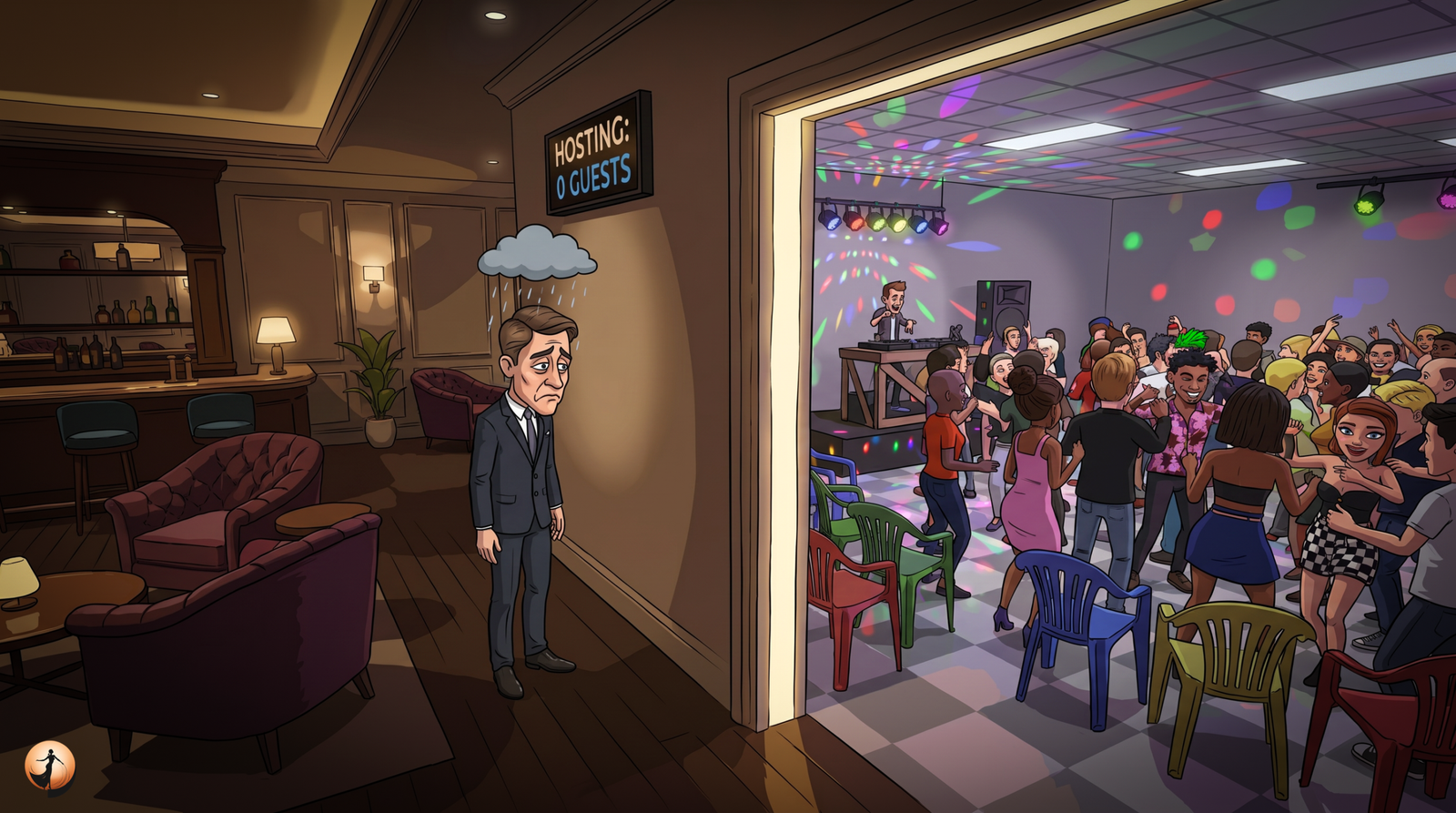
Or: Why your masterpiece is empty and someone else’s box with a bar is packed
There is a particular kind of tragedy in 3DX.
You open a room. Not just any room. A vision. Lighting tuned to perfection. Architecture that whispers taste. A layout that clearly says: serious people socialize here.
You wait.
A few avatars drift in. They look around. They hesitate. They perform a brief internal risk assessment.
They leave.
Meanwhile, across the hall, a room consisting of a flat floor, a DJ stream, and questionable furniture choices is absolutely heaving.
At some point, one must confront an uncomfortable possibility:
It’s not the room.
It’s you.
Hosting Is Not Opening a Door
Across every virtual world worth mentioning, from Second Life to VRChat to IMVU, the same misunderstanding quietly ruins beautiful spaces.
People think they are builders.
What they actually need to be… is hosts.
Opening a room is a technical act. Hosting is a social one. And the latter is where most rooms quietly fail.
A room without a host is not a venue.
It is a waiting room with better lighting.
The Awkward Truth About Empty Masterpieces
Let’s be blunt.
Beautiful rooms fail all the time. Not because they are flawed, but because they are finished.
They leave no room for people.
A highly curated space can feel like walking into someone else’s private party. Everything is already decided. The tone is set. The groups are formed. The message is subtle but unmistakable:
Observe. Don’t disturb.
And so… people don’t.
They leave instead. Politely. Efficiently. Often forever.
Elsewhere, in the Land of Basic Rooms
The “successful” room often looks like it was assembled in a mild hurry and a questionable mood.
And yet it works. Every time.
Why?
Because it makes a crucial promise:
You can belong here without trying too hard.
No one worries about standing in the wrong place. No one wonders if they are interrupting something important. No one feels like they need to earn the right to exist.
The room is not impressive. It is permissive.
And permissive spaces fill up.
The Host: Social Gravity in Human Form
A good host is not decoration. They are infrastructure.
They do three things, usually without even thinking about it:
- They acknowledge.
- They include.
- They sustain.
A simple “hey” at the right moment can stop someone from leaving. A well timed introduction can turn two strangers into a conversation. A small injection of energy can rescue an entire room from the brink of silence.
In VRChat communities, this is sometimes described as “social glue.”
In 3DX, it is usually just called good hosting.
The First Five Minutes
Where most rooms quietly lose people
Visitors make a decision very quickly.
Not about your lighting.
Not about your build quality.
About vibe.
- Did anyone notice me?
- Do I understand what’s happening here?
- Can I join without embarrassing myself?
If the answer to those questions is unclear, they are already halfway out the door… mentally if not physically.
And once someone has decided to leave, you rarely get a second chance.
Small Room vs. Big Crowd
Two completely different jobs, frequently confused
Here is where things get interesting, and where many otherwise good hosts quietly sabotage themselves.
Hosting five people is not a smaller version of hosting fifty.
It is a different skill entirely.
The Small Room: Intimacy Is the Product
In a small gathering, the room lives or dies on conversation.
Silence is loud. Awkwardness is contagious. One stalled moment can echo.
Your role here is connector in chief, whether you asked for the job or not.
- You introduce people who do not know each other.
- You pull quieter voices into the conversation.
- You smooth over pauses before they turn into exits.
Think less “host” and more “excellent dinner party guest who refuses to let things go flat, even at mild personal cost.”
Done well, a small room feels warm, personal, and oddly difficult to leave.
Done poorly, it feels like standing in an elevator that is taking just a bit too long.
The Large Room: Energy Is the Product
Once a room fills up, everything changes.
You cannot talk to everyone. You are no longer managing conversations. You are managing momentum.
Your job becomes:
- Keeping the overall energy alive.
- Creating focal points such as music, moments, or announcements.
- Letting micro-groups form without losing the room’s identity.
In Second Life event spaces, experienced hosts often describe this as “riding the wave.” You do not control every interaction, you guide the current and hope you do not wipe out in front of everyone.
Try to host a large room like a small one and you will burn out quickly… while the room quietly fragments around you.
The Dangerous Middle
The hardest phase is neither empty nor full.
It is almost alive.
Ten to fifteen people. Not quite a crowd. No longer intimate. Just enough activity to suggest something is happening, and just enough silence to prove that it isn’t.
This is where rooms either take off… or quietly collapse.
Here, the host must do both jobs at once:
Spark conversation and project energy.
It is a delicate balancing act, and the moment where many hosts disappear into private chats, unknowingly sealing their room’s fate.
The Builder’s Blind Spot
A gentle intervention, delivered with love
Builders love control.
Hosting requires letting go of it.
The most successful spaces are not the most detailed, they are the most usable.
They answer simple, human questions:
- Where do I go?
- Where do I stand?
- Who do I talk to?
If your room is a maze, a monument, or a masterpiece that demands admiration… it may also be quietly discouraging interaction.
People do not gather where they feel uncertain. They drift away from it.
The best rooms are not just seen.
They are inhabited.
Final Thought: The Room Is Not the Star
There is a persistent illusion in virtual worlds that the room creates the experience.
It doesn’t.
The people do.
And among those people, one role matters more than most:
- The one who says hello first.
- The one who keeps things moving.
- The one who turns space into atmosphere, almost without anyone noticing.
The host.
Everything else is just set dressing.
Very pretty set dressing, perhaps. But still.
A Modest Challenge
Next time your room feels quiet, resist the urge to rebuild it.
Resist the temptation to add more lighting, more detail, more things to admire.
Instead, ask a more uncomfortable question:
Am I hosting… or just waiting?
Be honest.
Your room already knows the answer.
The Unforgiving Hosting Checklist
A short list. None of it optional.
- If you’re AFK, you’re not hosting. You’re furniture.
- If newcomers aren’t greeted, expect them to leave. Quickly.
- If all your attention is in private chat, your room is already dying.
- If people don’t know where to stand, they won’t stay.
- If the energy drops and you don’t act, the room empties itself.
- If your space feels like a clique, it will become one. And then shrink.
- If you rely on the build to do the work, it won’t. Ever.
- If you wouldn’t enjoy walking in as a stranger… why would anyone else?
Rooms don’t die.
They are abandoned.